In Malaysia, workplace safety and health is not optional, It is a legal responsibility. One of the key principles used to manage workplace hazards effectively is the Hierarchy of Control. This framework is widely applied in safety management systems and aligns with the requirements under Malaysian occupational safety and health legislation.
The Hierarchy of Control provides a structured approach to identifying and controlling hazards by prioritizing the most effective control measures first, rather than relying solely on personal protective equipment (PPE).
Legal Basis in Malaysia
The application of the Hierarchy of Control is supported by several key Malaysian laws and guidelines, including:
- Occupational Safety and Health Act 1994 (OSHA 1994)
- Factories and Machinery Act 1967 (FMA 1967)
- DOSH Guidelines, including HIRARC (Hazard Identification, Risk Assessment and Risk Control)
Under Section 15 of OSHA 1994, employers are legally required to ensure, so far as is practicable, the safety, health, and welfare of employees at work. This includes providing safe systems of work, safe use of machinery and substances, and adequate information, instruction, training, and supervision. The Hierarchy of Control supports employers in fulfilling these legal duties by offering a systematic method to control risks.
Understanding the Hierarchy of Control
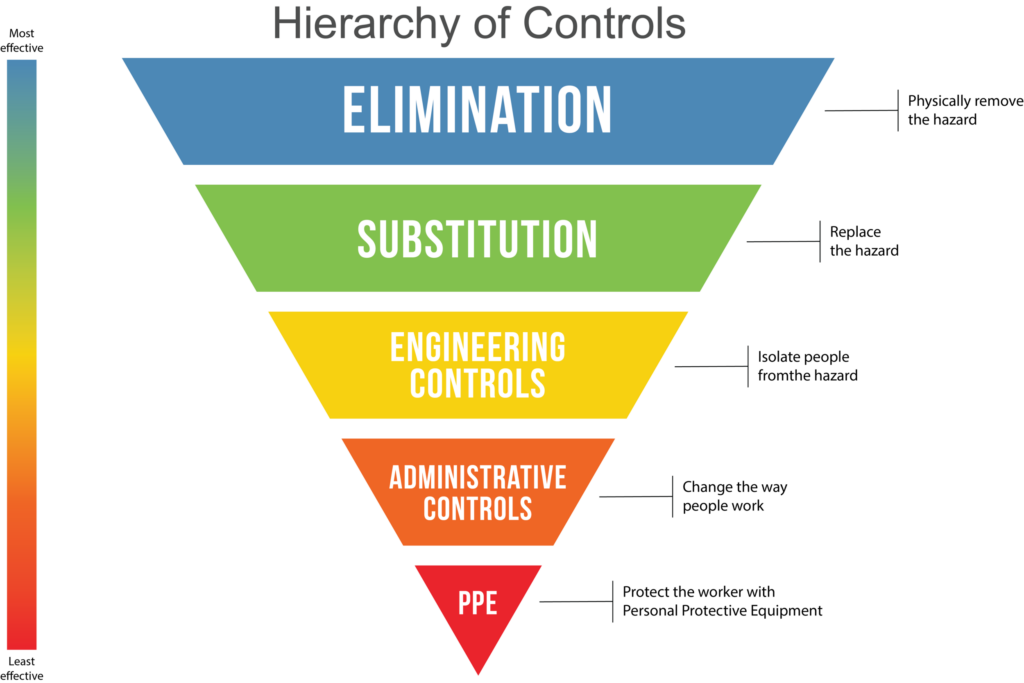
The Hierarchy of Control consists of five levels, arranged from the most effective to the least effective control method. The principle is clear:
the higher the level of control applied, the greater the reduction in risk. Malaysian safety regulations encourage organizations to control hazards at the source, rather than relying solely on worker behavior or PPE.
1. Elimination
Elimination involves completely removing the hazard from the workplace. This is the most effective form of control because it removes the risk entirely. In Malaysia, elimination is strongly encouraged during the design and planning stages of work activities. For example, eliminating work at height by redesigning tasks to be performed at ground level reduces the risk of falls, which are a leading cause of workplace accidents. Elimination supports an employer’s duty under OSHA 1994 to prevent exposure to hazards where reasonably practicable.
2. Substitution
When elimination is not feasible, substitution should be considered. This involves replacing hazardous materials, equipment, or processes with safer alternatives. For example, replacing a hazardous chemical with a less toxic substance helps reduce health risks to workers. This aligns with legal requirements under OSHA 1994 and FMA 1967 to ensure the safe use and handling of substances and machinery. Substitution reduces risk while maintaining operational efficiency.
3. Engineering Controls
l. Redesign– Jobs and processes can be reworked to make them safer. For example, containers can be made easier to hold and lift.
ll. Isolation – If a hazard cannot be eliminated or replaced, it can sometimes be isolated, contained or otherwise kept away from workers. For example, an insulated and air-conditioned control room can protect operators from a toxic chemical.
III. Automation – Dangerous processes can be automated or mechanized. For example, computer-controlled robots can handle spot welding operations in car plants. Care must be taken to protect workers from robotic hazards.
IV. Barriers – A hazard can be blocked before it reaches workers. For example, special curtains can prevent eye injuries from welding arc radiation. Proper equipment guarding will protect workers from contacting moving parts.
V. Absorption – Baffles can block or absorb noise. Lockout system can isolate energy sources during repair and maintenance. Usually, the further a control keeps a hazard away from workers, the more effective it is.
Vl. Dilution – Some hazards can be diluted or dissipated. For example, ventilation systems can dilute toxic gasses before they reach operators.
4. Administrative Controls
I. Safe work procedures – Workers can be required to use standardized safety practices. The employer is expected to ensure that workers follow these practices. Work procedures must be periodically reviewed with workers and updated
II. Supervision and training – Initial training on safe work procedures and refresher training should be offered. Appropriate supervision to assist workers in identifying possible hazards and evaluating work procedures.
III. Job rotations – and other procedures can reduce the time that workers are exposed to a hazard. For example, workers can be rotated through jobs requiring repetitive tendon and muscle movement to prevent cumulative trauma injuries. Noisy processes can be scheduled when no one is in the workplace.
IV. Housekeeping, and repair and maintenance programs – Housekeeping includes cleaning, waste disposal and spill cleanup. Tools equipment and machinery are less likely to cause injury if they are kept clean and well maintained.
V. Hygiene – Hygiene practices can reduce the risk of toxic materials being absorbed by workers or carried home to their families. Street clothing should be kept in separate lockers to avoid being contaminated by work clothing. Eating areas must be segregated from toxic hazards. Eating should be forbidden in toxic work areas. Where applicable, workers should be required to shower and change clothes at the end of the shift.
5.Personal Protective Equipment (PPE)
Personal Protective Equipment (PPE) is the last line of defence in the Hierarchy of Control. PPE protects workers from exposure but does not eliminate the hazard. Examples include safety helmets, gloves, goggles, safety shoes, and respiratory protection. Malaysian regulations require employers to provide suitable PPE where risks cannot be adequately controlled by other means. However, PPE should never be the primary control method. It must be used together with higher-level controls to ensure effective risk management.
Why PPE Alone Is Not Sufficient
Relying solely on PPE is not aligned with best safety practices or Malaysian legal expectations. PPE can be worn incorrectly, damaged, or removed, which may lead to exposure to hazards. Malaysian DOSH guidelines emphasize that hazards should be controlled at their source wherever practicable, making elimination, substitution, and engineering controls the preferred options.
The Hierarchy of Control is a vital tool for managing workplace hazards and ensuring compliance with Malaysian occupational safety and health laws. By prioritising higher level controls, organisations can significantly reduce risks and create safer working environments. At Hopedwell, we promote the application of the Hierarchy of Control to support legal compliance, enhance workplace safety, and protect workers health and wellbeing.