The integrity of any structure relying on anchors from temporary rigging to permanent fixings hinges on the pull-out capacity of those anchors. To ensure these critical components are correctly specified and installed, two rigorous testing procedures are mandated: Preliminary Anchor Testing and Anchor Proof Testing. These tests are essential quality control measures that directly impact safety and reliability.
1. Preliminary Anchor Testing: Verifying Design Suitability
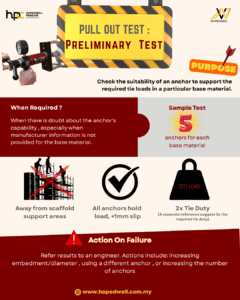
Preliminary anchor testing is the first line of defense, employed to verify that a specific type of anchor can adequately support the required loads in a particular base material. This testing is especially vital when the capability of an anchor is in doubt, or when the anchor manufacturer has not provided performance data for the specific base material encountered on site.
The Test Protocol
To establish a satisfactory safety margin without compromising the structure, a non-destructive approach is used.
- Sample Selection: A sample of five anchors must be tested for each distinct base material present within the project.
- Test Location: Crucially, these preliminary tests must be conducted away from the areas where anchors will actually support the structure, and the sample anchors must be discarded once the tests are complete.
- Target Load: The anchors are loaded in tension to a specified test load. This load is typically set at twice the tie duty the anchor is required to withstand. In some cases, the required test load may be three times the required tie duty.
- Acceptance Criteria: The anchor is deemed suitable for use in the base material if all five sample anchors successfully support the test load without slipping by 1 mm or more.
Addressing Test Failure
Failure of even a single anchor to support the test load is a significant finding that requires immediate consultation with an engineer. Several remedial actions can be considered to achieve the necessary performance:
- Increase the embedment depth or the diameter of the anchor.
- Substitute the component with a different type of anchor.
- Redesign the entire structural tie-in system to specify a lower tie duty.
If necessary, increase the number of anchors at each position to distribute and reduce the load on individual fixings.
2. Anchor Proof Testing: Confirming Quality Installation
Once an anchor type and base material combination has been validated by preliminary testing (or if no preliminary test was required), proof testing is conducted. The sole purpose of a proof test is to verify that the anchors have been installed correctly in the field. Proof tests are a necessity for all projects.
Proof Testing Scope and Load
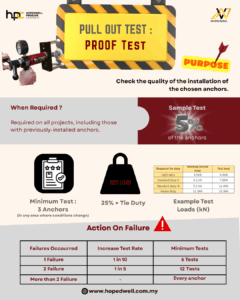
- Sampling: A rigorous sampling strategy is required for every project. At least 5% of the total anchors (1 in 20) must be tested, chosen at random.
- Discrete Areas: A minimum of three anchors must be tested in any discrete area where factors like different fixings, different base material, varying weather conditions during installation, or a different team of installers have worked.
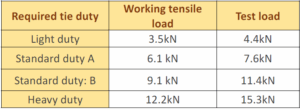
- Test Load: The sample anchors must be tested to a load that is 25% greater than the specified tie duty.
For example,
The Testing Process
The accuracy of the test is paramount, requiring strict adherence to procedure:
- The tests must be carried out by competent personnel.
- A test meter must be used, and its gauge must have been calibrated within the last twelve months to an accuracy of 5%.
- The load must be applied directly to the anchor, bypassing the tie tube or fixing to isolate the anchor’s performance.
- When testing in masonry, the hydraulic test rig’s feet must not rest on the masonry unit into which the fixing is drilled, to prevent artificially high readings or damage to the substrate.
Escalation on Proof Test Failure
Anchor failure during proof testing indicates a serious issue with the installation quality and necessitates an investigation into the causes. The immediate action is to double the proof-testing rate to re-establish confidence:
- First Failure: The test rate is doubled to 1 in 10 anchors, with a minimum of 6 tests.
- Second Failure: The test rate is doubled again to 1 in 5 anchors, with a minimum of 12 tests.
- Multiple Failures (More than two): If multiple failures occur, every single anchor must be tested, and the entire fixing specification and installation method must be thoroughly reviewed.
3. Visual Examination and Long-Term Integrity
Beyond initial pull-out tests, anchors must be regularly inspected throughout the project duration. This regular examination should include a visual inspection of the anchor and the surrounding structure for signs of distress, such as:
- Deformation or damage to the anchor.
- Rust seeping from the fixing.
- Cracks in the base material or mortar joints.
Furthermore, subsequent proof tests may be required following severe weather or any event that could undermine the structural support of the system.