
Third Party Inspection
Hopedwell > Engineering, Construction & Inspection > Third Party Inspection
Third Party Inspection
Hopedwell > Engineering > Third Party Inspection
"Truth is confirmed by inspection and delay, falsehood by haste and uncertainty." -Tacitus
A Third Party Inspection & Assessment (TPIA) or known as Authorised Inspecting Body (AIB) under the first schedule of regulation is an organization that has been officially recognized and authorized by the Department of Occupational Safety and Health (DOSH), Malaysia to conduct inspections and certifications for lifting machinery, pressure vessel and boilers that fall under statutory safety requirements.
The role of an AIB is to ensure that lifting machinery, pressure vessels, and other regulated plant are inspected, tested, and certified in accordance with national safety regulations and recognized standards under the fourth schedule before being operated.
These inspections help ensure that equipment is safe for use, structurally sound, and compliant with regulatory standards, thereby protecting workers, property, and the environment.


Certification Process
The process for obtaining a Certificate of Fitness generally involves several steps.
Step 1 – Machinery Registration
The machinery must first be registered with DOSH through the required submission documents.
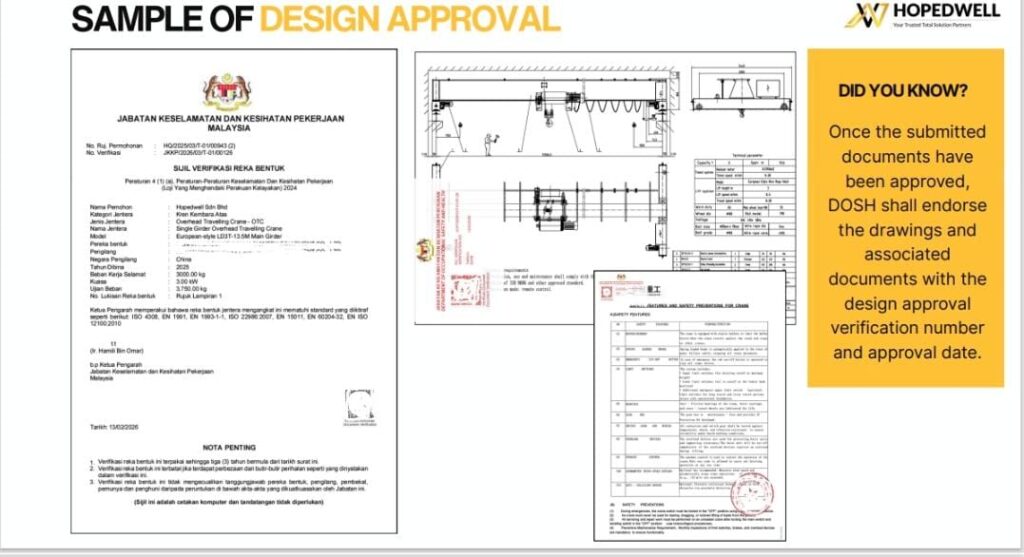
Step 2 – Design Approval
Engineering drawings, technical specifications, and safety features are reviewed and approved by DOSH.
Step 3 – Permit to Install (PTI)
Approval must be obtained before installation of the machinery.
Step 4 – Inspection and Testing
After installation, the machinery undergoes inspection and testing by DOSH or authorized inspectors.
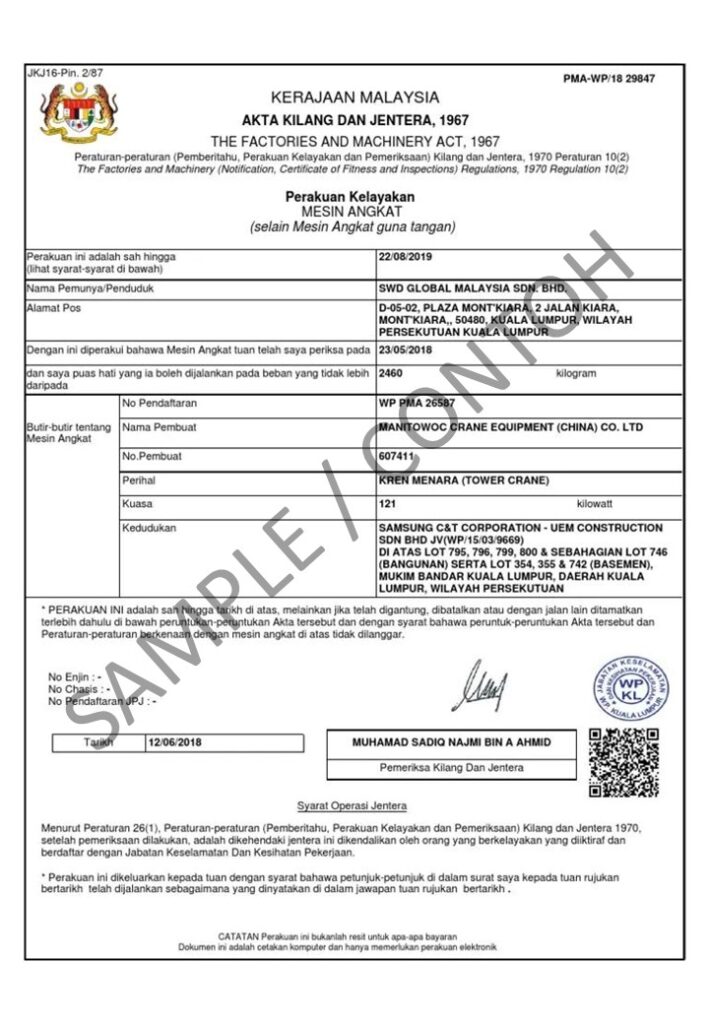
Step 5 – Certificate of Fitness Issuance
Once the machinery passes inspection, DOSH issues the Certificate of Fitness (CF) allowing the machinery to operate legally.
Step 6 – Periodic Inspection
Certified machinery must undergo regular inspections and renewal of certification to maintain compliance.
Why choose us?
- Experienced team in DOSH regulatory requirements
- Professional handling of documentation and submissions
- Efficient coordination with authorities
- Strong knowledge of plant safety regulations
- Support for both new and existing machinery certification
Types of Plant Requiring Certificate of Fitness
Examples of plant (Lifting Machinery, Pressure Vessel or Boiler) that typically require a Certificate of Fitness include but not limited to the followings:
- Lifting machinery - means any equipment for lifting, raising, transporting or lowering loads;
- Pressure vessel - means an enclosed vessel with pressure greater or less than atmospheric pressure;
- Steam boilers - means any closed vessel for any purposes which steam is generated under pressure greater than atmospheric pressure and includes any economiser used to heat water being fed to the vessel and any super heater used for heating steam and any pipes and fittings connected to the closed vessel;
Applicable Standard and Compliance
The activities are conducted in accordance with Malaysian Occupational Safety and Health (Plant Requiring Certificate of Fitness Regulations 2024 and Occupational Safety and Health (Special Scheme of Inspection) Regulations 2025 (SSI Regulations 2025).
Our team ensures that the entire process is efficient, compliant, and completed according to regulatory requirements.
Our services
- Plant registration with DOSH
- Design approval submission
- Permit to Install (PTI) application
- Assistance with inspection and testing procedures
- Preparation of documentation for certification
- Liaison with regulatory authorities
- Renewal of Certificate of Fitness
- Type Test or Integrity Test Inspection
We are qualified by


Interested in our services? Click the button below to request a quotation.